Your food storage isn't too small. It's too full of water.
The average prepper's shelf holds a fraction of the calories it could. Not because the
shelf is small — because almost everything on it is packaged at 600–900 calories per liter.
This manual shows you how to build rations at 5,000–6,500, in your own kitchen, that
don't go rancid in six months.
One-time $29
Emailed to you within seconds
Instant PDF deliveryNo subscriptionMetric & imperial
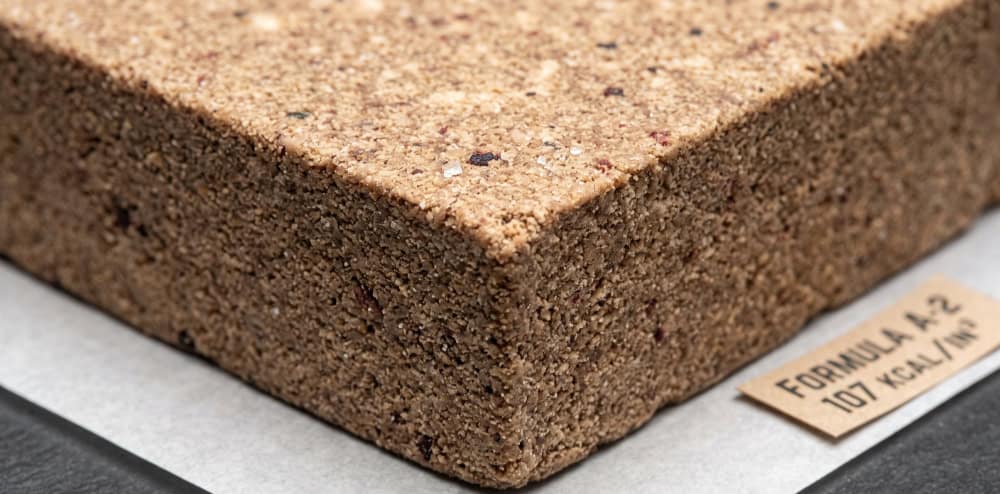
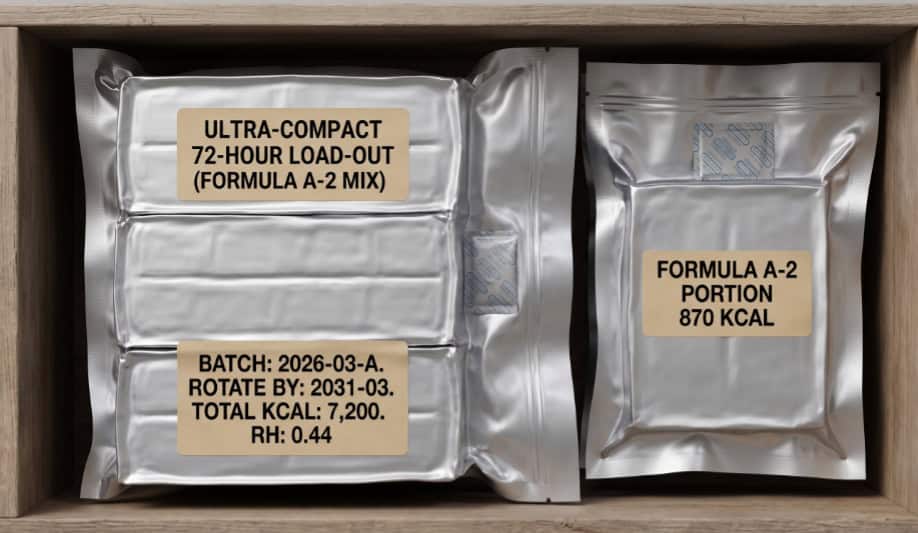
FORMULA A-2 — 107 kcal/in³, or 6,530 kcal/L. No air, no headspace, no water
to add later. This is what the density band at the top of the matrix actually looks like.
One 5-gallon bucket — store-bought pouches
5 days of food
~700 kcal/L is typical once you account for the air, the packaging, and the water
you're going to add back anyway. At 2,500 kcal/day, that bucket is a long weekend.
One 5-gallon bucket — Formula Manual rations
41 days of food
At 5,500 kcal/L the same bucket carries over a month per person. Same shelf, same
footprint, same closet. Eight times the endurance.
The real constraint
Nobody has a food problem. Everybody has a volume problem.
If you live in an apartment, keep a bug-out bag under 30 lbs, or share a basement with a
water heater and your spouse's Christmas decorations, you already know the ceiling isn't
money. It's cubic feet.
You bought "a year of food" and it fits in a closet you can't spare
Retail buckets are sold by serving count, not by calories. Those "servings" are often
150–200 kcal. A year's supply on the label is frequently four months of actual
sustenance — taking up the space of a year.
Every dense recipe you find online goes rancid
High calorie density means high fat. High fat means oxidation. The homemade energy
bars from the blogs taste like crayons by month four, and nobody explains why —
because the blogs don't know either.
Your bug-out bag is a 3-day bag pretending to be a 7-day bag
Once water, shelter and ammunition claim their share, food gets whatever volume is
left. Most bags carry 1,200 kcal/day at best — a slow deficit you'll feel on day three,
exactly when you need to think clearly.
Freeze-dried packages cost thousands and still ship you air
A $3,000 pallet doesn't fix density — it buys convenience and a headline number. You're
paying premium prices per calorie for nitrogen and empty headspace.
You've been told to "just store rice and beans"
Dry rice is around 2,900 kcal/L before cooking, which is respectable — until you
remember it needs 3× its volume in water and 20 minutes of fuel to become food.
Density on the shelf is not density at the point of use.
You don't know which of your stores will fail first
Best-by dates measure quality, not safety, and they assume storage conditions you
probably don't have. Without a way to reason about water activity and fat chemistry,
rotation is guesswork with a calendar taped to it.
Here is the part that changes everything: calorie density and shelf
stability are usually treated as a trade-off. Pack in more fat, get more calories, accept
faster spoilage. That trade-off is real, but it is not fixed — it's governed by three
variables most home preppers never touch: water activity, fatty
acid saturation profile, and oxygen exposure at the particle
surface.
Control those three and you can hold 5,500+ kcal/L for years, not months. That control is
what this manual teaches — and the Recipe Matrix is what it looks like once it's applied.
What's inside
A technical manual, then 40 formulas that apply it.
Roughly 120 pages. No filler chapters on why prepping matters — you're already here.
Sections 1–2 are the theory you need to modify anything safely. Section 3 is where
most readers live.
SEC 01
The Density Equation
How to compute and compare what you already own, so you can find the dead weight before you buy anything else.
Calculating kcal/L and kcal/kg for any food, with worked examples
The packing-efficiency correction most calculations forget
Density audit worksheet: rank your current stores worst to best
Why kcal/L is the right metric for shelves and kcal/kg is the right one for packs
SEC 02
Shelf Stability Without Refrigeration
The chemistry that decides whether your work lasts three months or seven years. This is the section that keeps you out of trouble.
Water activity (aw) explained plainly — and the 0.60 line that stops mould and bacteria cold
Measuring aw at home, including the cheap hygrometer method
Choosing fats by saturation profile: which ones survive years, which betray you
Antioxidant loading with rosemary extract and mixed tocopherols — dose rates included
Oxygen absorbers, mylar thickness, and the barrier mistakes that quietly undo everything
Rancidity triage: how to tell a bad batch from a fine one before you rely on it
SEC 03
The Recipe Matrix — 40 Formulas
Every formula on one page: ingredients by weight and percentage, method, measured density, projected shelf life, and the storage format it's designed for.
Sorted by kcal/L so you can pick for the space you have, not the recipe you like
Four bands: 3,000–4,000 / 4,000–5,000 / 5,000–6,000 / 6,000+ kcal/L
Cold-process formulas for anyone without an oven or dehydrator
No-cook, no-water rations for packs and vehicle kits
Cost per 1,000 kcal for every formula, so you can compare on budget too
SEC 04
Formulating Your Own
The substitution logic, so the matrix becomes a starting point instead of a ceiling.
Swap tables: which ingredients trade one-for-one and which change aw
Hitting a target density on purpose, with the arithmetic laid out
Protein, fat and micronutrient floors for extended-duration rations
Palatability engineering — because ration fatigue makes people stop eating
SEC 05
Packing, Labelling & Rotation
Turning batches into a system that survives contact with real life.
Container geometry: how to lose 20% of a shelf to round buckets, and how not to
Labelling standard that records batch, aw, density and date
A rotation schedule built on failure risk instead of arbitrary dates
Vehicle and cache storage under thermal cycling
Recipe Matrix — sample rows
Four of the forty, so you know what you're buying.
This is the format of every entry. Pick your constraint — shelf space, pack weight, no
cooking, scarce water — and read across. Every formula below is pictured on this page,
labelled with the same figures.
Formula
Density
Shelf life*
Equipment
Built for
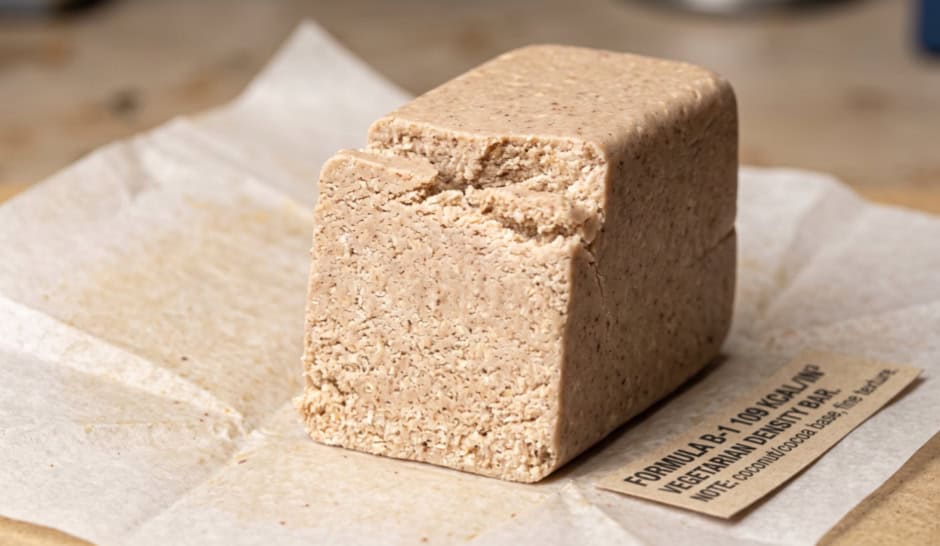
B-1 — Vegetarian Density Bar
6,650 kcal/L 109 kcal/in³
4–6 yr
Stovetop
Plant-based, coconut/cocoa base
A-2 — Dense Ration Block
6,530 kcal/L 107 kcal/in³
5 yr
None (cold press)
Maximum shelf density
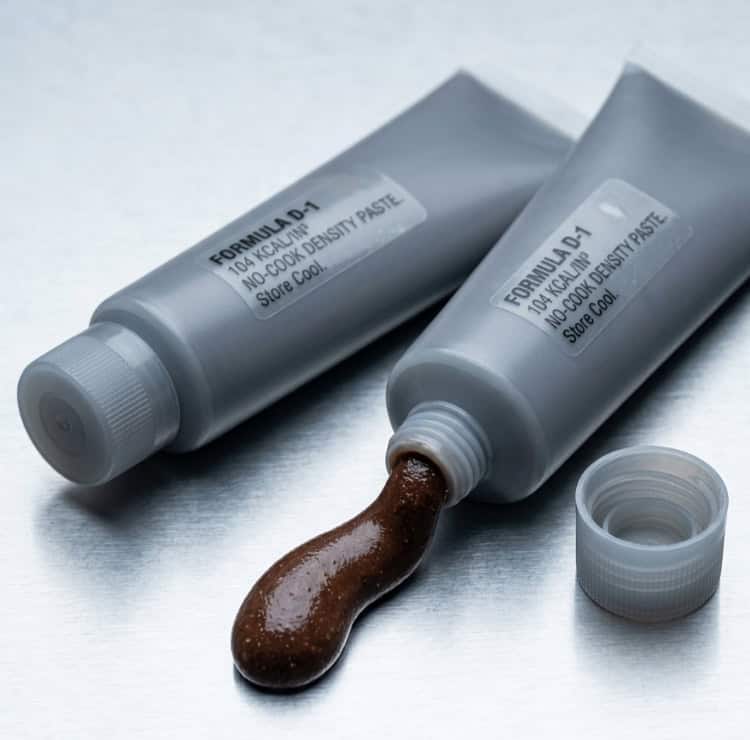
D-1 — No-Cook Density Paste
6,350 kcal/L 104 kcal/in³
Store cool
None
Bug-out bag, no cook, no water
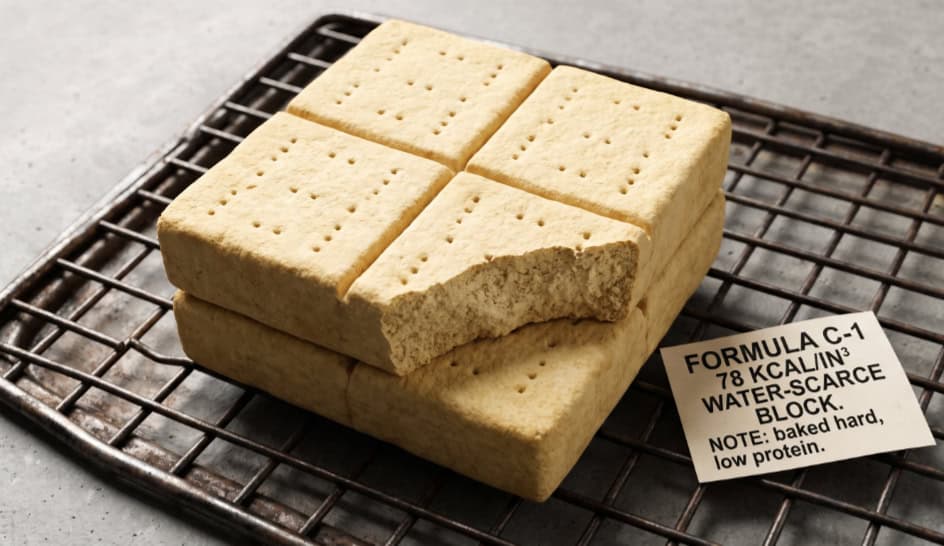
C-1 — Water-Scarce Block
4,760 kcal/L 78 kcal/in³
3–5 yr
Oven
Baked hard; eats dry, low protein
B-1 — the densest formula in the matrix, and fully plant-based. Coconut fat is roughly 90% saturated, which is why it reaches 6,650 kcal/L without trading away shelf life.C-1 — baked hard so it eats dry. Lower density is the deliberate price of needing no water at the point of use.D-1 — tubed paste for packs and vehicle kits. No cooking, no water, and it fills the awkward gaps a rigid block cannot.
* Projected shelf life at aw < 0.60, stored below 21 °C / 70 °F in
oxygen-barrier packaging with absorbers, per the method in Section 2. Storage above that
temperature shortens every figure — the manual includes the correction curve.
The Section 5 labelling standard in use: batch, rotate-by, total kcal
and measured RH 0.44 — comfortably under the 0.60 line — recorded on the pouch
itself. A full 72-hour load-out at 7,200 kcal, in a footprint you could lose in a drawer.
Honest fit
This is a technical manual. That suits some people and not others.
Buy it if…
Your storage is capped by space, not by budget
You want to understand why a formula works so you can adapt it
You're willing to spend an afternoon making a test batch
You're comfortable with a kitchen scale and percentages by weight
You'd rather build 40 days of food than buy 5
Skip it if…
You want ready-made food shipped to your door
You want quick weeknight recipes — this isn't a cookbook
You won't weigh ingredients; volume measuring will not hold aw target
You need certified medical or clinical nutrition guidance
You expect gourmet flavour — these rations are engineered for endurance first
Get it now
One file. One payment. Yours permanently.
High-Density DIY Survival Food Formula Manual
Technical Guide & Recipe Matrix · PDF · ~120 pages
$29ONE-TIME · NO SUBSCRIPTION · NO UPSELL
All 5 sections, ~120 pages
The full 40-formula Recipe Matrix
Density audit & batch-label worksheets
Metric and imperial throughout
Print-friendly; readable on phone, tablet or desktop
Emailed within seconds of payment, plus a download link
Secure checkout by Stripe · Card, Apple Pay & Google Pay
Questions
Frequently asked
What exactly do I receive, and how fast?
A single PDF — the complete Technical Guide and the full 40-formula Recipe Matrix,
around 120 pages. It's sent to your email address within seconds of a successful
payment, attached directly to the message, with a backup download link valid for 30
days.
If it hasn't landed in five minutes, check spam. If it's still missing, reply to your
Stripe receipt and it'll be re-sent by hand.
Do I need a freeze dryer or dehydrator?
No. A home freeze dryer costs more than most people's entire food storage, which is
precisely the problem this manual works around. Of the 40 formulas, 26 need
nothing beyond a stovetop, a bowl and a kitchen scale, and 11 of those need
no heat at all.
A dehydrator opens up a further handful of formulas and an oven a few more, but every
density band from 3,000 to 6,000+ kcal/L contains at least one no-equipment option.
Is this just pemmican with extra steps?
Two of the forty formulas are pemmican derivatives, and they're included because the
underlying principle is sound and it would be strange to leave them out. The other
thirty-eight are not.
More to the point, traditional pemmican is a recipe, and a recipe only helps when you
have exactly those ingredients. This manual is built around the variables — density,
water activity, fat profile — so you can hit a target with what's actually in your
region and your budget.
How long do these formulas really last? Those numbers look optimistic.
Fair scepticism. The figures assume the storage conditions stated under the matrix:
water activity below 0.60, under 21 °C / 70 °F, in oxygen-barrier packaging
with absorbers. Meet those and the numbers hold, because at aw below 0.60
microbial growth stops entirely and the only remaining clock is fat oxidation — which
is exactly what the fat-selection and antioxidant sections are there to slow.
Miss them and the numbers don't hold. A hot garage running 35 °C in summer can
cut projected life by half or worse. Section 2 gives you the temperature correction
curve rather than a single flattering figure, and Section 5 tells you how to tell a
failing batch from a sound one.
Can I get the ingredients at a normal supermarket?
For most formulas, yes. The matrix flags every formula by sourcing difficulty:
supermarket, bulk / warehouse, or online
speciality. Twenty-three of the forty are supermarket-only.
Two ingredients genuinely do warrant an online order — food-grade antioxidants
(rosemary extract, mixed tocopherols) and oxygen absorbers. Both are inexpensive,
both keep for a long time, and Section 2 explains what to buy and roughly what to pay
so you're not guessing.
I have allergies or dietary restrictions. Is this usable?
Partly, and it depends on the restriction. Every formula is tagged for the major
allergens, and there are dedicated nut-free, gluten-free and dairy-free tracks
through the matrix. Section 4's substitution tables tell you which swaps are
one-for-one and which will move your water activity — that distinction matters more
than taste.
Plant-based is better served than people expect. The densest formula in the whole
matrix — B-1, at 6,650 kcal/L — is meat-free, because its coconut base is roughly
90% saturated fat. Saturation is what resists oxidation, so a coconut-based formula
is both denser and more stable than most animal-fat alternatives. There is no density
penalty for going plant-based here.
Being straight with you about where it does get harder: complete protein and
B12 are the real constraints on a long-duration vegan ration, not
calories. Section 4 covers the amino-acid pairing that fixes the first, and is blunt
about supplementing the second.
Is homemade survival food actually safe?
It is when water activity is controlled, and it isn't when it's ignored — which is
the honest answer, and the reason Section 2 comes before the recipes. Shelf-stable
food preservation is well-understood science, not folklore; the failures come from
people copying a recipe without knowing which variable was keeping it safe.
The manual covers home aw verification, spoilage indicators, and the
specific failure modes to watch for. It also tells you plainly when to throw a batch
out. Please read Section 2 before your first batch, not after.
How is this different from free recipes online?
Free recipes give you a procedure. They rarely give you a measured density, a
projected shelf life tied to stated conditions, or any explanation of which
ingredient is doing the preserving. So when you substitute something — and you will,
because the shop was out — you have no way to know whether you've just made it
unsafe.
The value here isn't the forty formulas. It's that after Sections 1 and 2 you can
evaluate any recipe, including the free ones, and tell whether it will
survive the year.
Metric or imperial?
Both, side by side, throughout. Formulas are given as baker's percentages by weight
as well, which is what you'll want if you scale a batch up or down.
Is my payment secure? What do you see?
Payment is handled entirely by Stripe on their own hosted checkout page. Card details
never touch this site and are never visible to us. All we receive is your email
address, which is used to send the manual and nothing else — no list, no sequence, no
resale.
The shelf isn't getting any bigger.
Same closet, same bucket, same bag — five days of food or forty-one. The difference is
knowledge you can apply this weekend, and it costs $29.